
Boilers vs. Hoosiers: Purdue vs. Indiana — Which Big Ten School Actually Fits?
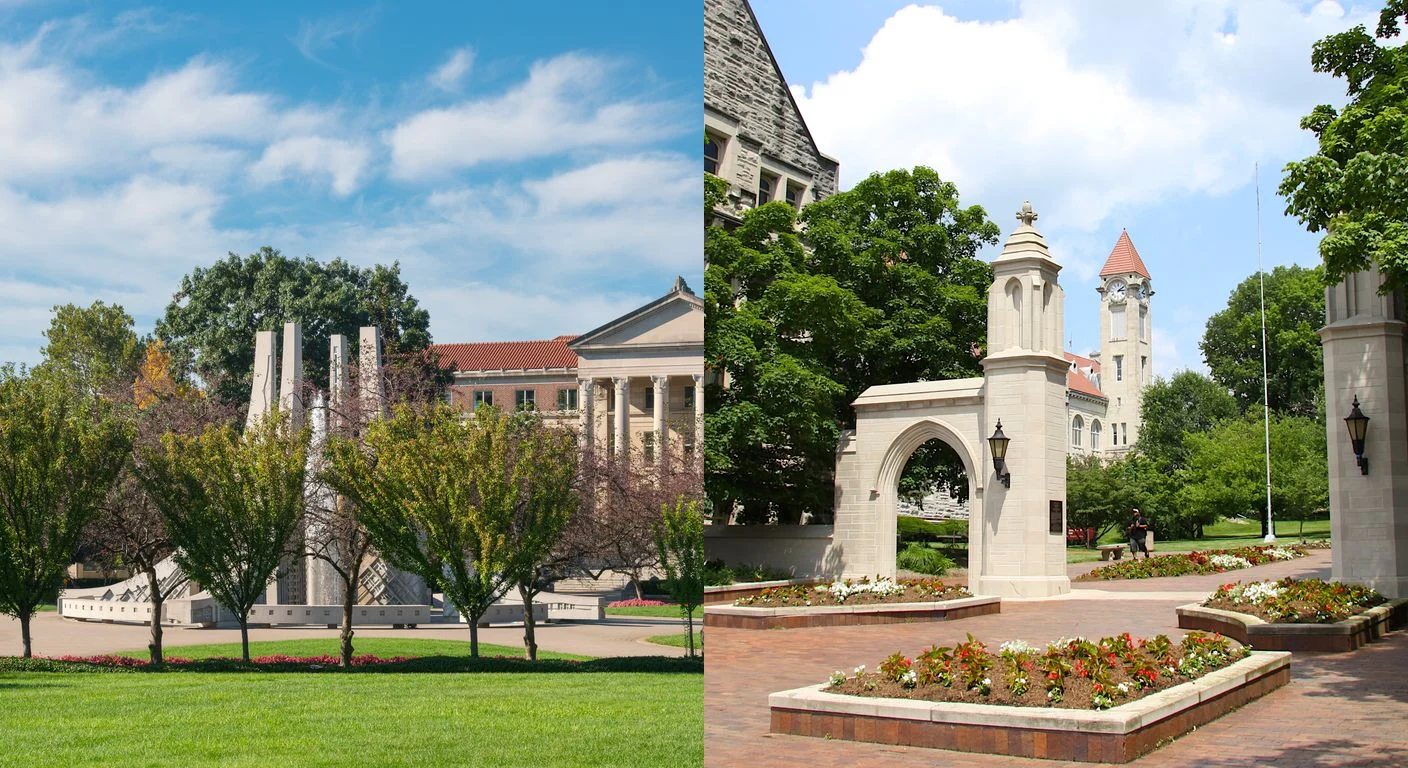
Indiana's two flagship campuses sit about two hours apart, and they could hardly be more different. Purdue University in West Lafayette is an engineering-and-science powerhouse that has become sharply more selective in just a few years. Indiana University Bloomington is a classic college town built around business, music, the arts, and, as of January, a national championship football team. Families often tour both on the same trip and walk away still unsure, because the differences are less about rankings and more about what a student's day actually looks like. Here's how they really compare. If you'd like a current student to walk you through either campus, SchoolScoops pairs you with one for a private tour.
By the Numbers
- Admit rate: Purdue admitted 43.4% of roughly 87,000 applicants for fall 2025, a record low. IU Bloomington admits closer to 78%.
- First-year class: Purdue enrolled 9,580 first-year students in fall 2025; IU enrolled 10,127. Both are big, and neither feels small.
- Testing: Purdue expects SAT or ACT scores again. IU is test-optional, and 45% of students admitted for fall 2025 applied without scores.
- Admitted student profile: IU's middle-50% admitted GPA was 3.73–4.00 with SAT scores of 1250–1450, per its official class profile. Purdue publishes college-by-college ranges on its class profile page.
- Major matters more at Purdue: Purdue admits by major, and some are far tighter than the overall rate. Nursing admitted about 29% and computer science about 43% for the Class of 2029.
- Location: Purdue sits about an hour northwest of Indianapolis; IU sits about an hour south. Neither is a big-city school, and both towns are built around the campus.
Academics: Engineering Engine vs. Professional-School Range
Purdue's identity starts with engineering. Most engineering students enter through First-Year Engineering, a common first year before moving into a specific discipline. That gives students room to explore, but it also means the first year is a shared, demanding curriculum with real pressure to perform. Students describe a culture that is collaborative out of necessity: problem sets get done in groups, late, in the engineering buildings around the Purdue Mall. Beyond engineering, Purdue's computer science, aviation, agriculture, and pharmacy programs have national reputations, and the professional flight program is one of the hardest majors to get into anywhere.
IU's strengths are spread wider. The Kelley School of Business is the biggest draw for out-of-state applicants, and it has its own visit programming worth booking. The Jacobs School of Music is one of the most respected music schools in the country and runs on auditions, not just grades. IU also has strong programs in public affairs, informatics, journalism, and the arts. The honest tradeoff: if a student is certain about engineering or hard science, Purdue is the more natural fit. If they're likely to change direction, or want business with a broad liberal arts backdrop, IU gives more room to move.
Campus Feel: Brick and Function vs. Limestone and Trees
Purdue's campus is red brick, orderly, and practical, centered on the Purdue Mall and the Engineering Fountain. It's busy in a purposeful way. You'll hear students joke that the campus looks like it was designed by engineers, and they mean it as a compliment. Neil Armstrong walked these quads, and the university leans into its "Cradle of Astronauts" history.
IU's Bloomington campus is one of the most visually striking in the Big Ten: Indiana limestone buildings, dense woods, and a creek running through the middle. The Sample Gates open directly onto Kirkwood Avenue, where campus blends into downtown restaurants and shops. Students who care about atmosphere often fall for IU on the first walk. Students who care more about efficiency tend to appreciate Purdue's layout once classes start.
Athletics and Traditions
The rivalry is real, and it's settled each fall in the Old Oaken Bucket game. Right now, the momentum belongs to Bloomington. Indiana Athletics is coming off a 27–21 win over Miami in January for the program's first College Football Playoff national title, and football Saturdays at IU feel different than they did even three years ago. Basketball remains the shared religion in this state: IU plays in Assembly Hall, Purdue in Mackey Arena, and both are among the loudest gyms in the country.
Purdue Athletics has the stronger recent basketball resume, and Mackey is the social center of winter for a lot of students. IU's signature non-athletic tradition is the Little 500, the student bike race made famous by the film Breaking Away, which takes over campus every April.
Housing and Daily Life
Both schools house most first-years on campus. Purdue Housing offers residence halls ranging from traditional doubles to the Honors College and Residences, and many students stay in university housing or nearby apartments in West Lafayette. IU's Residential Programs and Services runs a large network of halls and themed living-learning communities, and most upperclassmen move into apartments and houses near Kirkwood and the surrounding neighborhoods.
The daily rhythm is the biggest difference families underestimate. Purdue weekdays revolve around labs, problem sets, and team projects; social life exists but often fits around the workload. IU has a more traditional college-town social calendar, with Greek life, football, and downtown Bloomington pulling students out more often. Neither is better. They suit different people.
On cost, Purdue has held in-state tuition flat for more than a decade, which is rare among public flagships. Out-of-state families should compare net price at both using each school's calculator, since merit aid can shift the math either way.
Where They Diverge Most
- Selectivity: Purdue is now meaningfully harder to get into, especially by major. IU remains accessible, with competitive pockets like Kelley and Jacobs.
- Academic center of gravity: Purdue is STEM-first. IU is broader, with business, music, and the arts carrying as much weight as the sciences.
- Flexibility: switching majors is easier at IU. At Purdue, changing into a high-demand major can be competitive.
- Setting: Purdue is efficient and focused. IU is scenic and social, with a downtown that feels like part of campus.
- Testing: Purdue expects scores. IU is test-optional.
- Athletics right now: IU has the football moment; Purdue has the stronger recent basketball run.
Questions Worth Asking on Each Campus
- At Purdue: How hard is the transition from First-Year Engineering into the discipline you want, and what happens if you don't get your first choice?
- At Purdue: What does a normal Tuesday night look like during exam season?
- At IU: How competitive is it to stay in or transfer into Kelley, and what's the support like for students who aren't in it?
- At IU: How central is Greek life, and where do students who skip it find their people?
- At both: Where do upperclassmen live, and how early do they have to sign leases?
- At both: Which employers recruit heavily on campus for your intended major?
You can plan official visits through Purdue's visit page and IU's visit page, and review application requirements on Purdue's admissions site.
The Bottom Line
Purdue is the right call for a student who wants a focused, technical education with a strong return and doesn't mind a demanding first year. IU is the right call for a student who wants range, a classic college town, and room to figure things out. The fastest way to know which one fits is to hear it from students living it. Book a private tour at Purdue or Indiana University through SchoolScoops, or read how SchoolScoops works.
→ Ready to book? Visit SchoolScoops.com or browse all available schools to find your guide.
Photo credits
- Engineering Fountain Purdue University 2016 03.jpg — Julian Herzog (website); CC BY 4.0.
- Sample Gates, Indiana University Bloomington, 2010.jpg — IT Communications Office; CC BY 2.0.
Photos cropped and converted to WebP, then combined into a side-by-side composition.