
Beyond the Letters: The Best Colleges for Students Who Skip Greek Life
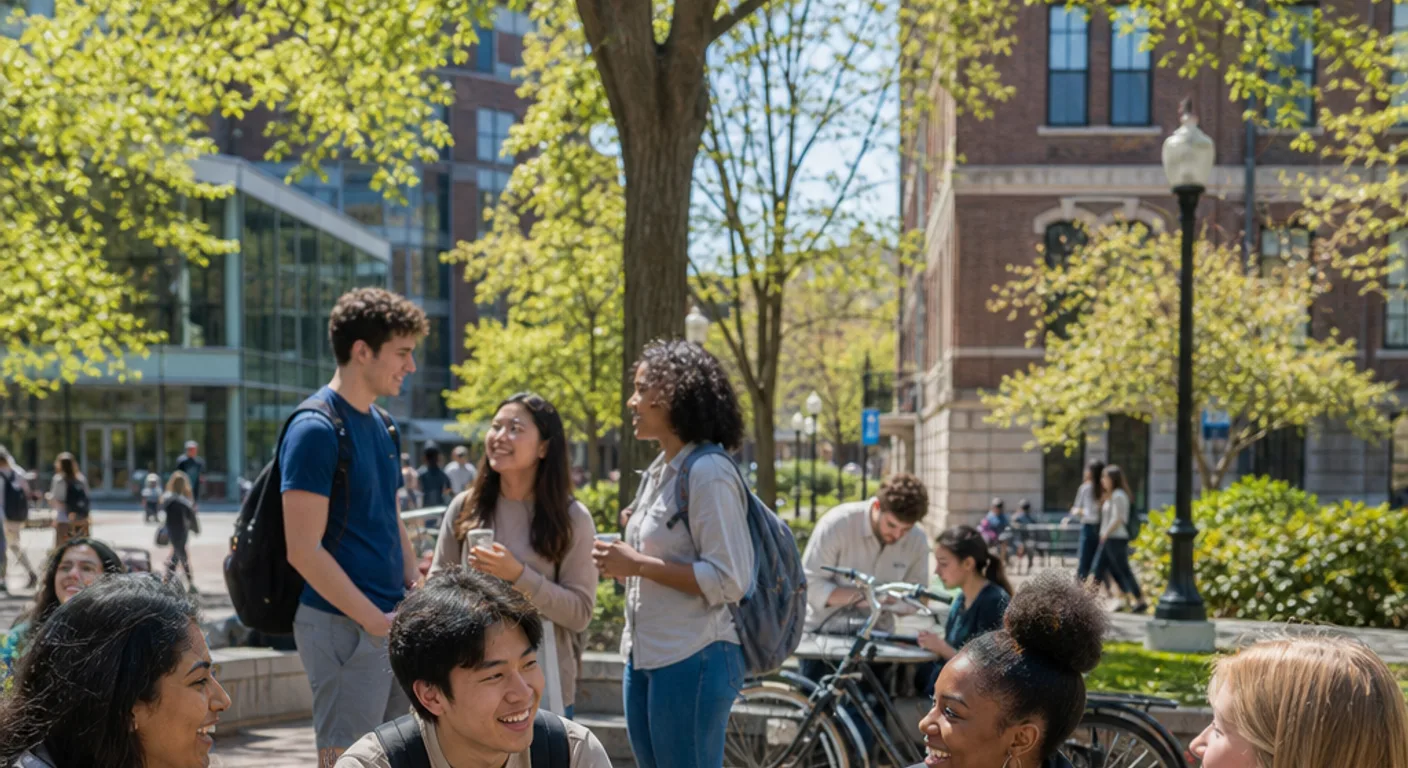
A lot of official tours are built around the assumption that Greek life is the default social infrastructure, which leaves students who already know they'll skip it with real, unanswered questions: what actually fills that space? Is the social scene genuinely strong without chapter houses, or just quieter? This list looks at schools where Greek life is a minority experience rather than the main event, and where something else — geography, a co-op program, a dense club scene — has clearly taken its place. It's a topic we hear about often on SchoolScoops tours, since it's rarely covered honestly in an admissions info session.
What to Look For Instead of Greek Life
- Dorm and suite culture that functions as the real friend-group incubator freshman year
- A surrounding city or town that supplies its own social calendar
- A dense club, activism, or org scene that carries genuine social weight, not just resume weight
- A structural reason — like a co-op program — that naturally decentralizes any single social institution
- A campus culture where opting out of rush is treated as a normal choice rather than a social risk
UC Berkeley
Berkeley's Greek scene exists, but it competes for attention with hundreds of student organizations and a politically engaged campus culture that gives students dozens of other ways to find their people. The sheer density of clubs — research groups, activist organizations, niche hobby collectives — fills much of the role fraternities and sororities occupy elsewhere, and Berkeley's location in a genuinely walkable, culturally active city adds another layer that doesn't depend on chapter membership at all. Students often describe finding their closest friends through a lab, a project team, or a co-op house rather than a chapter — and that's treated as the norm, not the exception. Housing details are available through Berkeley Housing.
UCLA
At UCLA, Greek life has a visible but contained presence, and the scale and diversity of Los Angeles means students who skip it rarely feel cut off from social or cultural life. Westwood's proximity and LA's sprawl shift a lot of weekend planning away from campus altogether, and UCLA's dorm and apartment communities tend to build tight-knit social circles on their own, independent of any chapter affiliation. See UCLA Housing for residential options.
University of Washington
University of Washington students describe outdoor culture — hiking, sailing on Lake Washington, skiing an hour from campus — as competing directly with, and often beating out, Greek social life. It helps that Seattle itself is a genuine city with its own draw, so the social calendar isn't dependent on any one campus institution. Housing and community options are detailed at UW Housing & Food Services.
Boston University
Boston University sits inside one of the biggest college cities in the country, with dozens of other universities within walking distance — which is a big part of why Greek life never became BU's social center of gravity. Whether or not you rush, the social options are functionally unlimited: other schools' events, the city's own nightlife and culture, and BU's own dense dorm culture all combine to fill the gap.
Northeastern University
Northeastern's defining social structure isn't Greek life — it's co-op. The university's signature work-integrated learning program has students rotating in and out of campus every few months, which naturally decentralizes any single social institution, Greek life included. Friend groups tend to form around co-op cohorts and returning-student reunions instead of rush cycles, and because a large share of any given class is off on a work placement at any moment, no single social structure — Greek or otherwise — ever fully dominates campus life. Student life resources are available through Northeastern Student Life.
University of Pittsburgh
Pitt students often describe their social scene as neighborhood-driven rather than chapter-driven — Oakland's dense mix of coffee shops, other universities, and off-campus apartments gives students plenty of ways to build community outside Greek life. Pitt's integration into a genuine city neighborhood, rather than an isolated campus, changes the social calculus considerably for students who never rush. See Pitt Student Affairs for more on campus life.
Questions Worth Asking Before You Decide
- What percentage of students actually go through recruitment, and how visible is Greek life outside of that group?
- Where do most freshman friend groups actually form, if not through a fraternity or sorority?
- How much does the surrounding city or town factor into weekend plans?
- Are there strong club or intramural communities that function like a built-in social group?
- What do upperclassmen who never joined say they'd tell an incoming freshman?
This is exactly the kind of nuance an official tour, built to present the university's full offering, usually isn't positioned to speak candidly about. If it's a question that matters to you, a current student can answer it far more specifically than any admissions FAQ — which is the whole premise behind SchoolScoops.
→ Ready to book? Visit SchoolScoops.com or browse all available schools