
Wisconsin vs. Minnesota: Badgers or Gophers? An Honest Big Ten Flagship Comparison
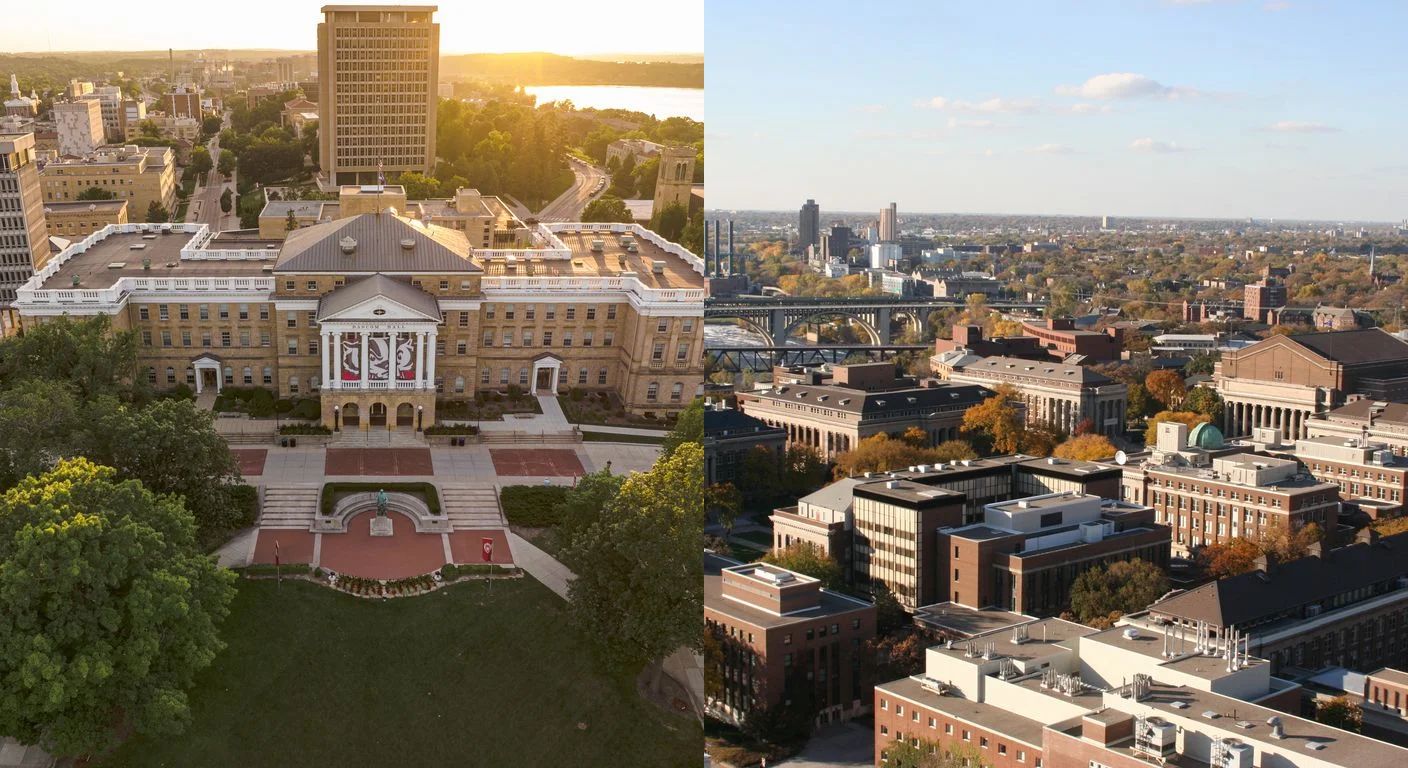
- Bascom Hall Sunset.jpg — Akira CA; CC BY-SA 4.0.
- UMN-NorthrupMall.jpg — Ben Franske; CC BY-SA 4.0.
Photos cropped and combined into a side-by-side composition. The adapted image is licensed under CC BY-SA 4.0; this license applies to the image, not the article.
The University of Wisconsin–Madison and the University of Minnesota Twin Cities have a lot in common: two big Big Ten flagships, a few hundred miles apart, with strong research, cold winters, and the longest-running rivalry in major college football. They also share an unusual tuition reciprocity agreement that makes them an especially natural pairing for students from either state. But the day-to-day experience is genuinely different. Madison is a classic college town built on an isthmus between two lakes; the Twin Cities campus is woven into a major metro area along the Mississippi River. Here’s how they compare — and if you want to hear it straight from current students, SchoolScoops can connect you with a guide at either school.
By the Numbers
Fall 2025 acceptance rate: Wisconsin: about 41% of 73,912 applicants · Minnesota: about 79% of 43,929 applicants
New first-years enrolled (fall 2025): Wisconsin: about 8,500 · Minnesota: 7,180
In-state tuition & fees: Wisconsin: about $11,600 · Minnesota: about $17,200
Out-of-state tuition & fees: Wisconsin: about $42,100 · Minnesota: about $38,400
Who has the easier path in?: Wisconsin: residents (56% vs. 41% nonresident) · Minnesota: nonresidents (85% vs. 64% residents)
That last line surprises people. Wisconsin is meaningfully more selective overall and favors its own residents. Minnesota is the rare flagship where out-of-state applicants are admitted at a higher rate than in-state ones — partly because so few nonresident admits actually enroll. But Minnesota’s campus-wide number hides real variation: the College of Science and Engineering admits a noticeably stronger academic profile than the university average. Pick your college at each school before you read too much into an overall acceptance rate.
The reciprocity piece is a big deal for students from these two states. Under the Minnesota–Wisconsin tuition reciprocity agreement, residents of one state can attend the other’s public universities without paying full out-of-state rates. Minnesota families can check full costs on One Stop.
Setting: The Isthmus vs. the Twin Cities
Madison is the quintessential Big Ten college town. Campus runs along Lake Mendota, Bascom Hill sits at one end and the State Capitol at the other, and State Street connects them with restaurants, shops, and a constant flow of students. The Memorial Union Terrace — with its sunburst chairs on the lakeshore — is where students spend warm afternoons, and the city is small enough that life largely revolves around the university. Students who love Madison say it feels like the whole city is in college with you.
Minnesota is a different animal. The main campus straddles the Mississippi River, with an East Bank and West Bank connected by the Washington Avenue Bridge, plus a separate St. Paul campus for agriculture and related programs. The Green Line light rail runs right through campus to downtown Minneapolis and St. Paul. Students get a real city — pro sports, concerts, and the corporate headquarters of companies like Target, 3M, General Mills, and Best Buy — but the campus can feel more spread out and less self-contained. Dinkytown is the closest thing to a classic campus strip.
Academics and Career Paths
Both schools are research heavyweights with broad offerings. At Wisconsin, the Wisconsin School of Business and the College of Engineering are big draws, and students in Letters & Science often point to the sheer range of majors and research labs available. Minnesota’s Carlson School of Management is a standout, partly because of its direct-admit structure and its location in a metro area dense with Fortune 500 employers — internships during the school year are more realistic here. The College of Science and Engineering is Minnesota’s other marquee program. The honest tradeoff: Madison’s career access is excellent but often means travel to Chicago or Milwaukee; Minneapolis puts the employers a light-rail ride away.
Game Days and Rivalry Culture
Wisconsin game days at Camp Randall are famous — the stadium-wide “Jump Around” between the third and fourth quarters is one of the great traditions in college sports, and Badger hockey and basketball draw big crowds too. Follow along at UWBadgers.com. Minnesota’s athletics (GopherSports.com) are a big part of campus life, especially hockey, but football Saturdays don’t dominate the social calendar the way they do in Madison. When the two meet, they play for Paul Bunyan’s Axe, the trophy in the most-played rivalry in major college football.
Housing and Winter Reality
At Wisconsin, first-year students talk about the Lakeshore vs. Southeast residence hall split — quieter lakefront halls on one side of campus, busier high-rise halls closer to State Street on the other. UW Housing explains the options. At Minnesota, University Housing offers a mix of traditional halls and apartment-style communities, and many students move into Dinkytown or Como apartments later.
Both schools have serious winters, and students won’t pretend otherwise. Madison students walk up Bascom Hill in January and wear it as a badge of honor. Minnesota has the Gopher Way, a network of tunnels and skyways that connects many campus buildings — a small detail that becomes very important in February.
Where They Diverge Most
- College town vs. major metro: Madison revolves around the university; the Twin Cities campus is part of a big city.
- Selectivity: Wisconsin admits about 41% overall; Minnesota admits about 79%, with big differences by college.
- Who’s favored: Wisconsin favors residents; Minnesota admits nonresidents at a higher rate.
- Cost for out-of-staters: Minnesota is a few thousand dollars cheaper on sticker tuition.
- Internship access: Minneapolis puts Fortune 500 employers nearby during the school year.
- Game-day culture: Camp Randall Saturdays are a bigger social anchor in Madison.
- Campus layout: Madison’s lakeside campus feels unified; Minnesota’s river-split campus feels larger and more urban.
Questions Worth Asking a Current Student
- How much does the social scene revolve around drinking, and how easy is it to opt out?
- How hard is it to get into your major once you’re admitted?
- At Minnesota: Do you use the light rail and the city regularly, or mostly stay near campus?
- At Wisconsin: Lakeshore or Southeast — what would you choose again?
- How do winters actually affect your mood and schedule?
- How big are your intro classes, and when did they get smaller?
- What advice would you give an out-of-state student? Official visit details are at UW-Madison Admissions and Minnesota Admissions.
Final Thoughts
If you want the full-on college-town experience — lakes, Saturdays at Camp Randall, a city that feels built around students — Madison is hard to beat. If you want a flagship that doubles as a launchpad into a major metro economy, Minnesota deserves a closer look than its acceptance rate might suggest. Visiting both and talking with students at each is the best way to tell which fits. See how SchoolScoops works to set that up.
→ Ready to book? Visit SchoolScoops.com or browse all available schools to find your guide.