
Arizona vs. Arizona State: Wildcats or Sun Devils? What Each Desert Campus Is Really Like
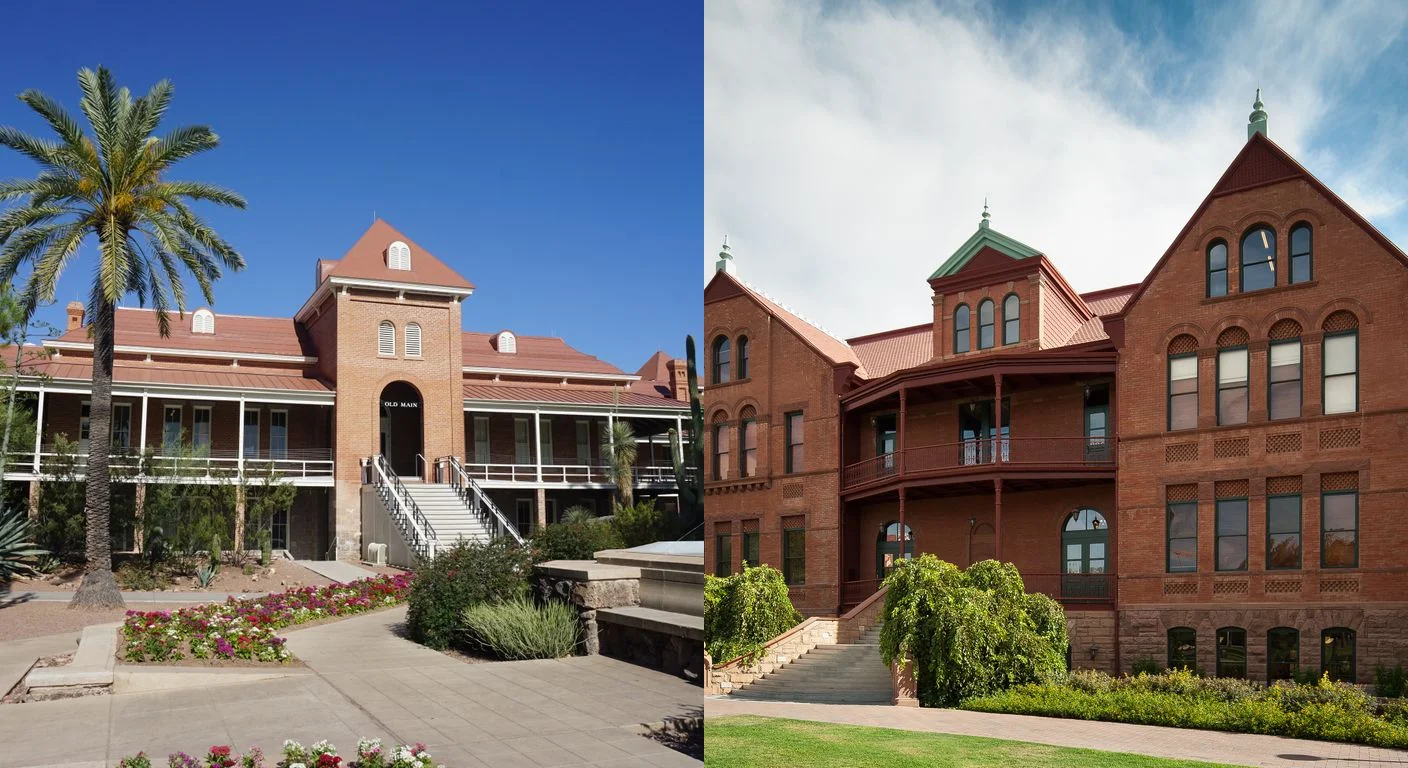
- University of Arizona May 2019 09 (Old Main).jpg — Michael Barera; CC BY-SA 4.0.
- Old Main - daylight.jpg — Landon Wiggs; CC BY-SA 4.0.
Photos cropped and combined into a side-by-side composition. The adapted image is licensed under CC BY-SA 4.0; this license applies to the image, not the article.
The University of Arizona and Arizona State University are about 110 miles apart, share a state, a climate, and (since 2024) a conference, and admit the large majority of the students who apply. That’s where the similarities stop. Arizona is the older, more traditional flagship in Tucson, with a red-brick campus and nationally known science programs. ASU is one of the largest universities in the country, a fast-growing, self-described innovation engine in the middle of the Phoenix metro. Students at each tend to have strong opinions about the other. If you want an honest read from someone on the inside, SchoolScoops connects you with current students at both. Here’s the lay of the land.
By the Numbers
Acceptance rate: Arizona: about 85% (fall 2025), rising to about 90% for fall 2026 · ASU: about 90%
Size: Arizona: about 43,300 undergraduates (54,384 total students) · ASU: 55,500+ students on the Tempe campus alone
Enrollment trend: Arizona: applications fell sharply heading into fall 2026 · ASU: a record fall 2025 class of 42,900 new students, including 17,900 first-years
Founded: Arizona: 1885, the first university in the Arizona Territory · ASU: 1885, as the Tempe Normal School
Conference: Arizona: Big 12 (joined 2024) · ASU: Big 12 (joined 2024)
The trend lines are worth paying attention to. ASU is still growing — and students are candid about the side effects, from general-education classes that fill fast at registration to parking permits that can run $400–$600 a year. Arizona went through a well-publicized budget crisis in 2023–24, and applications dropped sharply heading into fall 2026, especially from international and out-of-state students. Neither trend is a reason to rule a school out, but both are fair questions to ask on a visit.
Academics: Where Each School Is Strongest
Arizona’s academic reputation leans heavily on science. The Wyant College of Optical Sciences is one of the top optics programs anywhere, and the Lunar and Planetary Laboratory has led NASA missions, including OSIRIS-REx. Undergrads interested in astronomy, planetary science, or optics have real access to research that few public universities can match. The Eller College of Management is Arizona’s business draw, with well-regarded MIS and entrepreneurship programs.
ASU’s calling card is Barrett, The Honors College — a full residential honors college with its own complex on the Tempe campus, which gives high-achieving students a small-college community inside a giant university. The W. P. Carey School of Business and the Ira A. Fulton Schools of Engineering are both large and well-connected to Phoenix-area employers. ASU leans hard on its “most innovative” U.S. News ranking, and students do notice the emphasis on new programs, tech partnerships, and online options. The honest tradeoff: ASU’s scale gives you more options and more competition for them; Arizona’s smaller footprint can make research access easier in its strongest fields.
Campus and City: Tucson vs. Tempe
Arizona’s campus is built around Old Main and a long central mall lined with red-brick buildings and palm trees. Tucson is a mid-sized, relatively affordable city with a strong local food scene and serious outdoor access — Sabino Canyon for hiking and Mount Lemmon, which can be 20 to 30 degrees cooler than the valley floor, for escaping the heat. Students describe it as more laid-back and more “college town” than Tempe.
ASU’s Tempe campus sits next to Mill Avenue and Tempe Town Lake, with Valley Metro light rail connecting it to downtown Phoenix and the airport. That puts students in the middle of a metro area of about five million people, with internships, concerts, and pro sports close by. The heat is real at both schools, but Phoenix runs hotter, and the first few weeks of fall semester can be brutal. Expect to plan your day around shade and air conditioning in August and September.
Athletics and Rivalry
Arizona’s identity runs through basketball — McKale Center crowds are among the loudest in the sport — and its softball and baseball programs have long track records. Follow the Wildcats at ArizonaWildcats.com. ASU’s athletics (TheSunDevils.com) have momentum since the Big 12 move, and Sun Devil Stadium games bring out a big student section. The two schools play every year for the Territorial Cup, which is recognized as the oldest rivalry trophy in college football.
Housing and Student Life
Both schools have large freshman housing systems — see Arizona Housing & Residential Life and ASU Housing. At ASU, many students live in college-based residential communities, so engineers and business students often live together in their first year. At Arizona, students say the residence halls are closer to the center of social life, with the University Boulevard and Fourth Avenue areas nearby. Greek life is visible at both, and both have a reputation as social schools — students will tell you it’s easy to find a party and just as easy to find a club, research group, or intramural team if that isn’t your scene.
Where They Diverge Most
- Scale: ASU is one of the largest universities in the country and still growing; Arizona is big, but smaller and not in growth mode.
- Setting: Tempe is part of the Phoenix metro; Tucson feels more like a college town with mountains on all sides.
- Signature strengths: Arizona for optics, astronomy, and planetary science; ASU for Barrett Honors and its innovation-focused programs.
- Honors experience: Barrett is a full residential college; Arizona’s honors college is smaller and less central to the school’s identity.
- Institutional momentum: ASU is in expansion mode; Arizona is rebuilding after recent budget and enrollment challenges.
- Crowding: ASU students mention registration and parking pressure; Arizona students mention fewer of those growing pains.
- Sports identity: Arizona is a basketball school first; ASU’s football culture is the bigger fall draw.
Questions Worth Asking a Current Student
- How hard is it to get the classes you need, especially in your first two years?
- At ASU: How does Barrett change the experience — and is it worth it if you’re admitted?
- At Arizona: How have the budget cuts and enrollment changes shown up in your classes or services?
- How do you deal with the heat in August, September, and May?
- Do you need a car, or can you get by with light rail, the streetcar, and a bike?
- How easy is it to find a social life that doesn’t revolve around partying?
- What should out-of-state families know about merit aid? Official details are at Arizona Admissions and ASU Admission.
Final Thoughts
These two schools are a better match for different students than their shared acceptance rates suggest. Arizona suits students who want a traditional flagship campus in a smaller city with standout science programs. ASU suits students who want scale, an honors college that feels like its own school, and a major metro area outside their door. The best way to tell is to visit both and ask students what the brochures leave out. See how SchoolScoops works to book a student-led tour.
→ Ready to book? Visit SchoolScoops.com or browse all available schools to find your guide.